Fillomino Logic Puzzles: Integrating Deductive Reasoning into Creative and Professional Workflows
In the landscape of cognitive training and digital product creation, Fillomino logic puzzles represent a unique intersection of mathematical elegance and practical utility. Unlike standard sudoku or crossword formats, Fillomino relies on polyomino tiling and number partitioning, requiring a distinct mode of spatial reasoning. For professionals, educators, and content creators, this specific puzzle type serves two primary functions: it acts as a high-value asset for publishing portfolios and serves as a structured tool for cognitive maintenance. Understanding how to leverage a comprehensive library of 1,050 Fillomino puzzles across multiple difficulty tiers allows users to integrate this resource seamlessly into business workflows, educational curriculums, or personal productivity routines.
The Role of Fillomino in Cognitive Maintenance and Workflow Preparation
Before diving into the commercial or educational application of these assets, it is essential to understand the functional value of the puzzle itself within a daily routine. Logic puzzles are frequently categorized merely as entertainment, but in a professional context, they function as deductive reasoning exercises. For entrepreneurs, marketers, and freelancers who spend their days making high-stakes decisions based on incomplete data, the systematic elimination required in Fillomino mirrors the analytical processes used in business strategy.
Integrating a 5x5 easy-level Fillomino session before starting a complex project can serve as a cognitive warm-up. The smaller grid size offers a quick feedback loop, allowing the brain to engage pattern recognition and logical sequencing without inducing fatigue. This preparation phase is critical for knowledge workers transitioning from passive consumption to active creation. By solving a puzzle that requires determining region sizes based solely on numerical clues, the mind shifts into a state of focused attention. This is particularly useful during the planning stages of a project where structural integrity and rule adherence are paramount.
During periods of creative block or decision paralysis, shifting to a medium-difficulty 7x7 puzzle provides a productive diversion. Unlike doom-scrolling or unstructured breaks, which can fragment attention, engaging with a logic problem maintains mental engagement while resetting the specific neural pathways associated with the stalled task. The 7x7 variation strikes a balance between challenge and solvability, making it ideal for short breaks between deep work sessions. It reinforces the habit of systematic problem-solving, reminding the user that complex issues can be resolved through incremental, logical steps rather than intuitive leaps.
Leveraging Puzzle Assets for Content Creation and Publishing
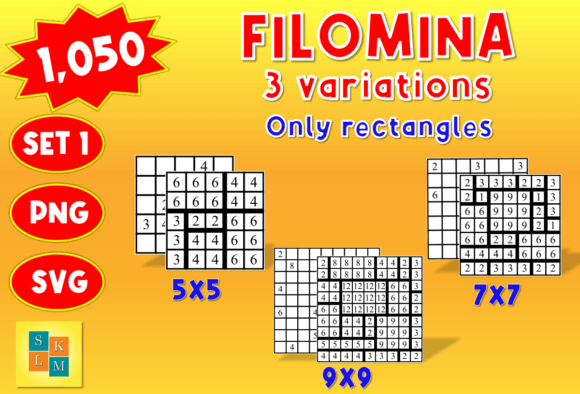
For publishers, bloggers, and digital product creators, this collection of 1,050 puzzles is less about personal solving and more about asset management and product development. The inclusion of SVG and PNG files for all three grid sizes (5x5, 7x7, and 9x9) addresses a significant bottleneck in the puzzle book creation workflow: scalability and print readiness. Vector-based SVG files ensure that puzzles remain crisp at any physical dimension, which is a non-negotiable quality standard for print-on-demand services and professional publishing.
When building a puzzle book or an educational worksheet series, consistency is key to user retention. Having a pre-validated set of 350 puzzles per difficulty tier eliminates the variability often found when generating puzzles algorithmically on the fly. Creators can map out an entire curriculum or book structure knowing exactly what assets are available. For example, an educator designing a semester-long logic course can assign 5x5 puzzles for introductory modules, progress to 7x7 for intermediate skill-building, and utilize 9x9 grids for final assessments. The attached notes on recommended tools further streamline this process by suggesting compatible software for layout and compilation, reducing the technical friction between acquiring assets and publishing the final product.
The organization of these files supports efficient batch processing. Because the puzzles are categorized by size and difficulty, creators can automate parts of their layout workflow. Scripts or templates designed for 5x5 grids can be applied universally to that subset of files, ensuring uniform margins, font sizing, and solution page formatting. This systematic approach to asset utilization transforms a raw zip file into a scalable product line, whether the end goal is a KDP paperback, a downloadable PDF bundle, or a subscription-based newsletter feature.
Strategic Implementation Across Difficulty Tiers
The three variations included in this listing are not merely different sizes; they represent distinct cognitive loads and use cases. Understanding these distinctions allows for better integration into specific workflows.
5x5 Easy: Onboarding and Accessibility
The 350 easy 5x5 puzzles are optimized for low-barrier entry. In a business context, these are ideal for lead magnets or freebies designed to introduce an audience to your brand’s aesthetic and quality standards. For educators or therapists working with neurodivergent individuals or those recovering from cognitive fatigue, the 5x5 grid provides achievable wins that build confidence without overwhelming working memory. In app development or UX testing, these smaller grids serve as perfect test cases for interface responsiveness and touch-target accuracy before scaling up to larger formats.
7x7 Medium: Skill Development and Engagement
The medium 7x7 puzzles occupy the "flow channel" for most adult solvers. They are sufficiently complex to require notation and forward-thinking but small enough to be solved in a single sitting of 10–15 minutes. For content creators, this tier offers the highest versatility. These puzzles work well as daily challenges in email newsletters, team-building icebreakers in corporate workshops, or supplementary material in STEM education. The 350-puzzle volume ensures that a daily publication schedule can be maintained for nearly a year without repetition, providing long-term value for subscription models.
9x9 Hard: Mastery and Premium Positioning
The 350 hard 9x9 puzzles cater to enthusiasts and experts. In a product ecosystem, these justify premium pricing or advanced tier memberships. They require sustained focus and advanced deduction techniques, making them suitable for competitive events, timed challenges, or certification benchmarks. For personal use among professionals, tackling a 9x9 grid serves as a rigorous mental endurance test, analogous to heavy lifting in physical training. Integrating these into a weekly review or reflection ritual can help maintain sharp analytical faculties over the long term.
Quality Control and Technical Integration
A critical aspect of using pre-made puzzle assets is verification. While this collection includes solutions for every puzzle, best practices dictate a sampling protocol before mass distribution. Users should solve a random selection from each difficulty tier to verify that the provided solutions match the puzzles and that the difficulty grading aligns with their specific audience's expectations. This quality control step prevents customer support issues and protects brand reputation.
Compatibility with existing design ecosystems is another practical consideration. The dual provision of SVG and PNG formats ensures interoperability across platforms. SVGs are preferable for Adobe Illustrator, Inkscape, or Affinity Designer workflows where resizing and color manipulation are necessary. PNGs serve as reliable fallbacks for Canva, PowerPoint, or web-based platforms that may struggle with vector rendering. Maintaining both formats in an organized directory structure reduces friction when switching between tools or collaborating with designers who have different software preferences.
The included notes on puzzle creation tools add a layer of meta-utility. Even if you are using pre-made puzzles now, understanding the generation process helps in evaluating future assets or creating custom variations. Familiarity with the underlying algorithms and software recommendations enables creators to troubleshoot layout issues, modify puzzle density, or eventually transition to proprietary content generation if their business scales beyond licensed assets.
Long-Term Value and Routine Integration
Sustainable integration of Fillomino logic puzzles requires treating them as a renewable resource rather than a disposable activity. For individuals, this means rotating through difficulty levels to prevent adaptation and plateauing. A mixed routine that alternates between quick 5x5 warm-ups and intensive 9x9 sessions maximizes cognitive benefits across different domains of executive function.
For businesses and creators, the value lies in the depth of the library. With 1,050 total puzzles, this asset pack supports multi-year planning. Rather than exhausting the content quickly, strategic deployment extends its lifecycle. A publisher might release one 7x7 puzzle per day in an app while reserving the 9x9 collection for annual anthology books. An educator might use the 5x5 set for student homework while keeping the harder variants for teacher training or professional development workshops. This layered approach to asset utilization ensures that the investment continues to yield returns across different segments and time horizons.
Ultimately, Fillomino logic puzzles offer a structured framework for both mental exercise and creative production. Whether used to sharpen deductive reasoning before a strategic meeting or to populate a new line of educational products, the key to success lies in intentional implementation. By respecting the distinct characteristics of each grid size, maintaining rigorous quality standards, and aligning the puzzles with specific workflow objectives, users can transform a simple zip file into a powerful component of their professional and personal development toolkit.