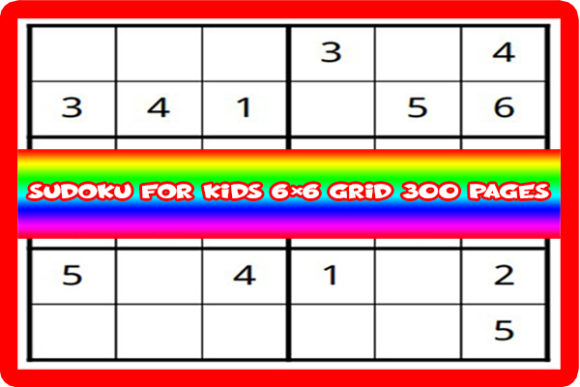
Sudoku for Kids 6×6 Grid: Leveraging an Evergreen KDP Niche
The landscape of self-publishing on Amazon KDP has shifted significantly over the last few years. While high-content books require immense time investment and low-content journals face market saturation, medium-content activity books remain a sweet spot for sustainable income. Among these, the Sudoku for Kids 6×6 Grid stands out as a particularly resilient asset. This format bridges the gap between early childhood development and pre-teen logic training, making it an evergreen niche that resists seasonal trends. For creators, marketers, and educators looking to build a portfolio of digital assets, understanding the specific utility and production advantages of this grid size is essential for long-term success.
Unlike the standard 9×9 grid which can be intimidating for novices, or the overly simplistic 4×4 grid which lacks longevity, the 6×6 format offers a perfect cognitive balance. It utilizes numbers 1 through 6 within six rows, six columns, and six 2x3 subgrids. This structure provides enough complexity to engage developing minds without causing frustration. For KDP publishers, this specific interior file represents more than just a single product; it is a scalable foundation. With 300 pages of expertly crafted puzzles, solutions included, and formatted for 8.5 x 11 no-bleed printing, this resource allows for the creation of multiple distinct titles or comprehensive activity bundles.
The Cognitive Sweet Spot in Modern Child Development
Current educational trends emphasize "scaffolded learning," where tasks are designed to grow with the child’s ability. Parents and educators are increasingly seeking screen-free alternatives that support executive function skills like working memory, cognitive flexibility, and inhibitory control. The 6×6 Sudoku grid aligns perfectly with these developmental needs. It serves as an accessible entry point for beginning puzzle solvers aged five to seven, while still offering sufficient challenge for children up to age ten who are refining their logical deduction skills.
This broad age applicability is a significant commercial advantage. In a market where hyper-niching is often advised, the 6×6 grid allows for a wider total addressable market within a single book. A parent purchasing this book for a six-year-old may find it remains relevant for two or three years, increasing the perceived value. Furthermore, as homeschooling and supplementary education continue to evolve post-pandemic, resources that combine entertainment with stealth learning are in high demand. The 6×6 format is frequently used in special education and ESL contexts because the reduced variable set lowers cognitive load, allowing learners to focus purely on the logic mechanics rather than number recognition fatigue.
Strategic Advantages of the 6×6 Format for Publishers
For entrepreneurs and freelancers managing a KDP business, efficiency dictates profitability. The 6×6 grid offers unique production benefits that streamline the publishing workflow. Because the grid is smaller, it allows for larger print sizes within the same page dimensions. This is critical for the target demographic; younger children require larger cells to write comfortably. An 8.5 x 11 inch page can accommodate four 6×6 grids with ample white space, whereas fitting four 9×9 grids would result in cramped, unusable layouts for kids.
The provided 300-page interior file maximizes this efficiency. Rather than generating new puzzles for every single title, smart publishers utilize this master file to create series variations. You might publish a "Sudoku for Ages 5-7" using the first 100 pages, a "Logic Puzzles for Grades 2-3" using the middle section, and a "Travel Activity Book" using a curated selection from throughout. This modular approach reduces upfront design costs and accelerates time-to-market. Additionally, the inclusion of solutions at the end adds immediate professional polish, eliminating the need for separate answer key generation and reducing potential errors during the layout phase.
Design Specifications That Drive User Satisfaction
Success in the activity book niche relies heavily on user experience (UX), even in print. Negative reviews often stem not from puzzle quality, but from physical usability issues. The specification of wide margins in this 8.5 x 11 no-bleed template addresses one of the most common pain points: binding interference. When puzzles are printed too close to the gutter, children cannot write in the inner cells without breaking the spine or straining their hands. Wide margins ensure that every puzzle is fully accessible, which directly correlates to higher customer satisfaction and better organic rankings.
The "easy to tear out" feature implied by generous margins also caters to modern usage habits. Parents and teachers frequently remove individual pages to distribute in classrooms, use during car rides, or display completed work. Designing with this physical interaction in mind transforms a static book into a flexible tool. Furthermore, the no-bleed requirement simplifies the printing process and reduces the risk of trimming errors. For creators uploading to KDP, adhering to safe zones and avoiding bleed ensures consistent quality across both paperback and potential future formats, protecting the brand reputation associated with your publisher account.
Diversification and Cross-Niche Opportunities
While a standalone Sudoku book is viable, the true potential of this 300-page asset lies in hybridization. The current market favors variety packs that offer sustained engagement. The 6×6 Sudoku interior can be seamlessly merged with other compatible games to create premium-priced activity books. Consider pairing Sudoku with mazes, word searches, or dot-to-dots. The 6×6 grid acts as a palate cleanser between more visually intense activities, providing rhythmic variety that keeps children engaged longer.
This merger strategy also opens up new keyword opportunities. Instead of competing solely for "kids sudoku," a hybrid book can rank for "summer brain teasers," "road trip activities," or "preschool workbook." The 6×6 grid is particularly effective in these combinations because its compact size leaves room for other elements without bloating the page count. For marketers, this means a single interior file can support multiple marketing angles and seasonal campaigns. A book positioned as "Back to School Logic Prep" in August can be repositioned as "Winter Break Brain Games" in December simply by changing the cover and metadata, all while utilizing the same core 6×6 content.
Navigating Quality Standards in an Evergreen Market
Because Sudoku for kids is an evergreen niche, competition is established. However, much of the existing inventory suffers from poor curation or automated generation artifacts. To succeed, creators must prioritize quality over sheer volume. Expertly crafted puzzles imply a human touch in verification. Automated generators sometimes produce puzzles with multiple solutions or illogical progression curves. Utilizing a pre-vetted 300-page file mitigates this risk, but publishers should still perform spot checks. Ensuring that difficulty scales appropriately—from simple single-missing-number clues to more complex intersection logic—is what separates a bestseller from a return-prone product.
E-E-A-T (Experience, Expertise, Authoritativeness, and Trustworthiness) applies to activity books as well. Your book description and author bio should reflect an understanding of child development or puzzle design. Highlighting features like "teacher-tested difficulty levels" or "screen-free cognitive development" signals to algorithms and buyers that this is a purposeful educational tool, not just filler content. The inclusion of complete solutions further demonstrates thoroughness. In a digital-first world, providing a reliable, error-free analog experience builds trust with parents who are increasingly discerning about the quality of offline materials they introduce to their children.
Practical Implementation for Immediate Upload
For those ready to capitalize on this niche, the path from file to live listing requires strategic execution. Start by segmenting the 300-page master file based on your specific angle. If targeting beginners, select the easiest 100 puzzles and increase font size. If creating a comprehensive volume, use the full range. Ensure your PDF export settings match KDP’s exact specifications for 8.5 x 11 no-bleed to avoid rejection or formatting warnings. The wide margins should be verified in the previewer to confirm they provide adequate writing space.
Cover design is equally critical. While the interior is standardized, the cover must signal the specific age group and value proposition. Use bright, clear typography and imagery that reflects the 6×6 grid specifically; showing a 9×9 grid on the cover for a 6×6 book leads to returns and negative feedback. In your backend keywords, leverage semantic terms related to logic, critical thinking, and specific age ranges. Finally, consider the series potential immediately. Set up a series name before uploading the first book to ensure subsequent volumes link correctly. This 300-page resource is not merely a single upload; it is the infrastructure for a scalable publishing imprint focused on enduring educational value.