Mnemonic Vocab Synonyms Sheet: A Practical Guide to Lasting Vocabulary Retention
Expanding your vocabulary is often viewed as a tedious exercise in rote memorization, particularly for adults and advanced students who need to master complex language for academic or professional success. Traditional flashcards and repetitive writing drills frequently fail because they rely on short-term memory rather than deep cognitive encoding. The Mnemonic Vocab Synonyms Sheet from Artistic Wisdom offers a structured alternative that bridges the gap between initial exposure and permanent retention. By leveraging associative memory techniques, this resource transforms abstract definitions into concrete mental images, making the learning process both efficient and genuinely engaging for educators, parents, and self-directed learners.
Understanding the Cognitive Barrier to Vocabulary Acquisition
Before implementing any new study tool, it is essential to understand why traditional methods often fall short. For learners in grade 10 and above, as well as adults preparing for standardized tests or professional communication, the challenge is rarely intelligence; it is the lack of semantic hooks. When you encounter a new synonym without context or association, your brain treats it as isolated data. Without a neural pathway connecting the new term to existing knowledge, recall becomes difficult under pressure.
The Mnemonic Vocab Synonyms Sheet addresses this specific cognitive bottleneck. Instead of presenting words in a vacuum, it utilizes mnemonic devices—memory aids that link new information to familiar concepts through visualization, rhyme, or narrative. This approach aligns with how the adult brain naturally processes and stores information. Whether you are an ESL teacher supporting language acquisition or a parent homeschooling a high schooler, recognizing this barrier is the first step toward selecting resources that actually work.
How the Mnemonic Vocab Synonyms Sheet Enhances Learning
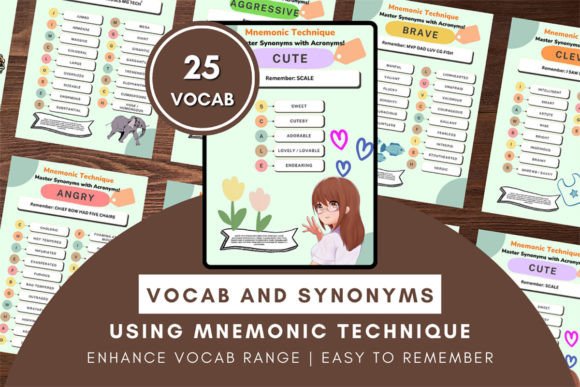
This resource is meticulously designed to move beyond simple definition matching. It provides a curated list of 25 carefully selected vocabulary words and their synonyms, each paired with a proven mnemonic technique. The value lies not just in the word list itself, but in the systematic application of memory science. Here is how this sheet facilitates deeper learning:
- Associative Encoding: Each entry creates a mental bridge between the target word and a vivid image or phrase, reducing the cognitive load required for retrieval.
- Synonym Clustering: Learning words in related groups rather than isolation helps build a robust semantic network, improving both comprehension and expressive fluency.
- Active Engagement: The format encourages learners to interact with the material creatively, shifting them from passive recipients to active participants in their own education.
- Standardized Test Alignment: The selected vocabulary targets high-frequency terms found in SAT, ACT, GRE, and TOEFL exams, ensuring practical relevance for test-takers.
By integrating these elements, the Mnemonic Vocab Synonyms Sheet serves as more than a reference document; it acts as a scaffold for developing independent learning strategies that persist long after the specific words have been mastered.
Tailored Applications for Different User Groups
While the core methodology remains consistent, different users will leverage this sheet to meet distinct objectives. Understanding these variations ensures you get the maximum return on your investment of time and effort.
For Educators and Tutors
Teachers often struggle to make vocabulary instruction engaging without sacrificing rigor. This sheet can serve as a weekly anchor activity. Rather than assigning generic lists, educators can use the mnemonics as discussion starters, asking students to evaluate the provided memory aid or create their own based on the model. This metacognitive practice reinforces the vocabulary while teaching students how to learn. It is particularly effective for differentiated instruction, providing a concrete support structure for students who struggle with abstract language processing.
For Homeschooling Parents
Parents teaching grades 10 and above may feel ill-equipped to teach advanced vocabulary nuances. The Mnemonic Vocab Synonyms Sheet removes the guesswork by providing expert-vetted associations. You can integrate this into a daily routine as a low-stress, high-impact activity. Because the mnemonics are designed to be memorable and often humorous, they reduce the friction associated with language arts instruction, turning potential conflict points into moments of shared discovery.
For Adult Learners and Professionals
Adults seeking to elevate their professional communication or prepare for graduate entrance exams require efficiency. Rote memorization is incompatible with busy schedules. This sheet allows for micro-learning sessions where five words can be effectively encoded in ten minutes using the provided cues. The focus on synonyms is particularly valuable for professionals aiming to eliminate repetitive language in writing and speaking, directly enhancing clarity and persuasiveness in workplace contexts.
Practical Implementation Strategies for Maximum Retention
To fully realize the benefits of the Mnemonic Vocab Synonyms Sheet, users should adopt implementation strategies that reinforce the mnemonic connections over time. Simply reading the sheet once is insufficient; spaced repetition and active recall are necessary companions to mnemonic encoding.
- Visual Reinforcement: Encourage learners to sketch the mnemonic image next to the word. The act of drawing engages motor memory and visual processing, creating a dual-coding effect that significantly boosts retention.
- Contextual Application: After reviewing the sheet, write original sentences using at least three new synonyms. This transfers knowledge from recognition to production, which is the ultimate goal of vocabulary building.
- Spaced Review Cycles: Revisit the sheet at increasing intervals (e.g., 1 day, 3 days, 1 week). The mnemonics serve as rapid retrieval cues during these reviews, making maintenance far less time-consuming than relearning.
- Peer Teaching: Have students explain the mnemonic to a partner or family member. Articulating the memory aid requires deep processing and reveals any gaps in understanding before they become entrenched.
Considerations for Effective Use
While the Mnemonic Vocab Synonyms Sheet is a powerful tool, its effectiveness depends on mindful usage. Mnemonics are scaffolds, not replacements for contextual understanding. Users should always verify word meanings in authentic texts to ensure the mnemonic hasn't oversimplified nuance. Additionally, if a provided mnemonic does not resonate personally, learners should feel empowered to adapt or replace it. Memory is highly individual; the best mnemonic is the one that sticks for you.
Furthermore, consistency matters more than volume. Mastering 25 words deeply through this method yields better long-term results than superficially covering 100 words through traditional lists. The goal is quality of encoding, not quantity of exposure. By respecting the cognitive principles underlying this resource, users can transform vocabulary building from a chore into a sustainable, enjoyable practice.
Elevating Language Skills Through Intentional Practice
Vocabulary enhancement is ultimately about expanding one’s capacity to think, communicate, and connect with ideas. The Mnemonic Vocab Synonyms Sheet from Artistic Wisdom provides the structural support needed to make this expansion accessible and enduring. Whether you are guiding a classroom, supporting a child’s education, or investing in your own intellectual growth, this resource offers a proven pathway past the limitations of conventional study methods.
By embracing mnemonic techniques, you are not just learning words; you are upgrading your learning architecture. The result is a richer, more precise vocabulary that serves you reliably in academic, professional, and personal contexts. In a world where clear communication is a critical asset, having the right tools to build that skill is not a luxury—it is a necessity. This sheet represents a practical, research-aligned solution for anyone ready to move beyond memorization and toward true mastery.