Evaluating Color Sort Preschool Learning Activities for Early Childhood Education
Color sorting is a foundational cognitive task in early childhood education that extends far beyond simple hue identification. A Color Sort Preschool Learning Activity serves as a multifaceted tool designed to develop visual discrimination, fine motor skills, and early mathematical concepts such as categorization and pattern recognition. When educators and parents evaluate resources for color instruction, they are often looking for materials that balance structured learning with developmental appropriateness. Understanding the specific utility, benefits, and limitations of color sorting activities is essential for determining whether this approach aligns with current curriculum goals or individual student needs.
The Role of Color Sorting in Cognitive Development
At its core, a color sort activity requires a child to observe an object, identify its primary attribute, and make a decision based on established criteria. This process engages executive functioning skills, specifically working memory and cognitive flexibility. While many associate these activities solely with art or basic vocabulary, they are fundamentally logic exercises. For preschoolers, the ability to sort by color is often a precursor to sorting by shape, size, and eventually numerical value.
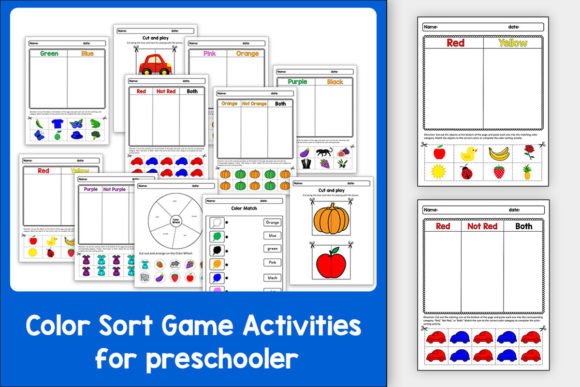
Educators researching this topic should recognize that effective color sorting resources provide more than just colored paper. They offer a scaffolded progression from matching identical colors to distinguishing between similar shades. The inclusion of specific color mats—ranging from primary colors like red, blue, and yellow to secondary and neutral tones like orange, green, purple, black, and white—allows for differentiated instruction. This breadth ensures that the activity remains relevant as students advance from basic recognition to more complex classification tasks.
Evaluating Implementation Strategies: Stations, Enrichment, and Intervention
When selecting a color sort resource, it is practical to evaluate how the materials function across different instructional settings. Versatility is a key indicator of long-term value. High-quality resources typically support multiple modalities of engagement:
- Learning Stations: Hands-on stations transform passive observation into active exploration. In this context, color sorting provides a tactile anchor for young learners. Evaluators should look for materials that are durable and self-explanatory, allowing students to engage with minimal adult direction during rotation-based learning.
- Enrichment and File Folder Sorts: For students who have mastered basic identification, enrichment activities must prevent boredom. File folder sorts offer a contained, interactive format that deepens curriculum engagement without requiring extensive setup. These are particularly useful for extending learning for advanced students who need to practice speed, accuracy, or multi-attribute sorting.
- Morning Work Routines: The start of the school day sets the tone for learning. Color sorting activities serve as effective morning work because they are low-stakes yet cognitively activating. They help transition children from home to school environments by providing a familiar, manageable task that builds confidence before more demanding lessons begin.
- Targeted Intervention: Not all students acquire color concepts at the same rate. Effective resources allow for isolation of specific variables. If a student struggles specifically with distinguishing blue from purple, having discrete mats and manipulables allows educators to tailor practice without overwhelming the learner with the full spectrum.
- Independent Practice: Autonomy is a critical developmental milestone. Materials designed for independent use foster self-regulation and focus. When evaluating resources, consider whether the visual cues are clear enough for a child to self-correct without constant teacher validation.
Benefits and Practical Considerations
The primary benefit of integrating a Color Sort Preschool Learning Activity into a teaching toolkit is the development of visual processing skills that underpin literacy and numeracy. Distinguishing between 'b' and 'd' or recognizing number symbols relies on the same neural pathways used to differentiate red from orange. Furthermore, these activities naturally incorporate vocabulary building and social language when performed in pairs or small groups.
However, there are tradeoffs to consider. Color sorting can become repetitive if not varied. Educators must assess whether a resource offers enough variation to maintain interest over several weeks. Additionally, reliance solely on 2D printed mats may limit sensory integration. It is often necessary to supplement paper-based resources with 3D manipulatives, textured objects, or real-world items to ensure a holistic learning experience. Another consideration is accessibility; approximately 8% of males and 0.5% of females have some form of color vision deficiency. Resources that rely exclusively on color without secondary cues (such as shapes or labels) may inadvertently exclude or frustrate these students. Evaluators should prioritize inclusive designs or plan adaptations accordingly.
Determining Fit: When to Use Color Sorting vs. Alternatives
Deciding whether to implement a dedicated color sort unit depends on specific classroom data and observational evidence. This type of activity is a strong fit when:
- Students demonstrate difficulty with visual discrimination or following one-step directions.
- The curriculum introduces a "Color of the Week" or thematic unit requiring reinforcement.
- Fine motor practice is needed alongside cognitive tasks, as picking up and placing small items builds pincer grasp strength.
- Assessment data indicates a gap in foundational attribute recognition.
Conversely, alternatives may be worth considering if students have already achieved mastery of basic color identification. In such cases, continuing basic sorting may lead to disengagement. Educators might instead pivot to activities involving color mixing, light and shadow exploration, or cultural studies regarding color symbolism. If the goal is purely artistic expression rather than cognitive categorization, open-ended painting or collage projects may be more appropriate than structured sorting games. Additionally, if a classroom has limited storage space or preparation time, digital color sorting apps or integrated environmental sorting (e.g., cleaning up toys by color) might offer a lower-maintenance alternative to physical file folders and mats.
Making Informed Decisions for Classroom Resources
Ultimately, the decision to adopt a specific Color Sort Preschool Learning Activity should be driven by pedagogical intent rather than aesthetic appeal. When comparing resources, evaluate the scope of included materials. A comprehensive set covering red, orange, yellow, green, blue, purple, black, and white provides the necessary range for both remediation and extension. Assess whether the resource supports the specific logistical needs of your environment, such as durability for high-traffic stations or clarity for independent morning work.
Educators should also reflect on their assessment strategies. Color sorting activities generate observable data; teachers can easily track which students hesitate, which confuse specific hues, and which complete tasks with automaticity. Selecting resources that facilitate this kind of formative assessment adds significant value beyond the immediate activity. By viewing color sorting through the lens of cognitive development and instructional versatility, educators can select tools that genuinely enhance the preschool learning journey, ensuring that time spent on color concepts translates into broader academic readiness.